

Kajabi Out-Visions Me Every Time: The Compounding Logic of a Platform That Won’t Sit Still
May 18, 2026Five new products launch between May 19 and June 1, 2026. The releases matter. The pattern they demonstrate matters more.
Most people choose a course platform once and never think about the choice again. I have thought about it a lot. Here is why.
In November 2015, late in the month, Kajabi launched what they called New Kajabi and opened a window to become a Kajabi Founder. I could not afford it. The rent was due. I had to choose between paying the rent on time and becoming a Founder. I became a Founder. The rent money came a little later.
That decision has shaped the last ten and a half years of my business. At the time, I was juggling a WordPress site for content and a Joomla learning platform for courses, with all the friction and patchwork integration that implies. Kajabi let me put everything under one roof, for the first time. The platform looked better. It worked better. It removed the operational tax I had been paying for years to keep two systems talking to each other.
Most people still file Kajabi mentally as “the course platform.” That filing was out of date years ago. It is meaningfully more out of date now.
TL;DR: Kajabi's May 2026 Release Cycle
For those evaluating the platform's trajectory, here is what Kajabi is rolling out to all plans at no extra cost:
- Cofounder: An integrated AI business partner that trains on your specific launch data.
- Backstage: A private, unified portal to replace the duct-tape stack for high-ticket coaching clients.
- Amplify: A built-in newsletter ad network to monetize your list between launches.
- Kajabi MCP: Conversational AI platform control that turns admin tasks into text prompts.
- Expert Agents: 24/7 AI sales and teaching assistants trained on your voice and content.
Between May 19 and June 1 of this year, Kajabi is releasing five distinct products — Cofounder, Backstage, Amplify, Kajabi MCP, and Expert Agents — each of which would have been the headline launch of a smaller company’s entire year. None of them cost extra. All of them ship into every Kajabi plan. If you are already on the platform, your subscription just absorbed them.
That is the part most people miss when they evaluate platform decisions. The price you pay today buys you not just what the platform is, but the trajectory the platform is on. And the trajectory matters more than the feature list.
Ten Years of Arrivals: The Evolution of Kajabi's Course Platform
Here is the part of the case I want to make concrete before I describe the May releases, because the May releases are not the argument. They are the latest instance of the argument.
When I signed up in November 2015, Kajabi was a course platform with a few supporting tools. That is what I bought. That is not what I currently run my business on.
The Coaching Product arrived a few years in. I did not see it coming. I had not asked for it. The moment it landed, my product ladder reorganised around it, and a third of what I do today exists because that capability arrived. Eleven years in, I cannot picture the business without it.
The Newsletter feature arrived. The Podcast feature arrived. The Branded App arrived — a capability that lets me put my coaching practice on each client’s phone or tablet, available the way any other app on their home screen is. None of that existed when I joined. All of it is sitting inside the subscription I have been paying for the last decade. Most of it I use. Some of it I do not yet use but know I will grow toward.
The one I am explicitly aiming for next is Community — Kajabi’s social platform inside the platform. It is too powerful for where my business currently sits, but I can see the version of my business that uses it, and I am building toward that version. The fact that it is already there, already integrated, already part of the workflow I already know — that is the thing the trajectory argument hinges on.
Kajabi runs a Labs module where subscribers can see what is currently being built and opt in to test new features in beta. Every quarter, that module looks different. New features arrive. Existing features get upgrades. The pace has only accelerated in the last four or five years.
When I look back across ten and a half years, the pattern is not that I migrated tools or platforms as my business grew. The pattern is that the platform I was on kept growing the capabilities I was about to need. Sometimes I had asked for them. More often, I had not realised I needed them until they arrived.
This is what I mean by trajectory. Not the feature you can see today. The features that arrive over the years, one after another, faster as the company matures, each one adding latent capability to the same subscription you signed up for at the beginning.
The May 2026 release cycle is the clearest single instance of that pattern I have seen.
Five New Kajabi 2026 Releases (Cofounder, Backstage, Amplify, MCP, Expert Agents)
Five products in two weeks is unusual. Even by Kajabi’s own cadence, after ten and a half years of watching them ship, five releases inside a two-week window is unusual. The deeper signal is not the speed. It is the architectural coherence of what they shipped.
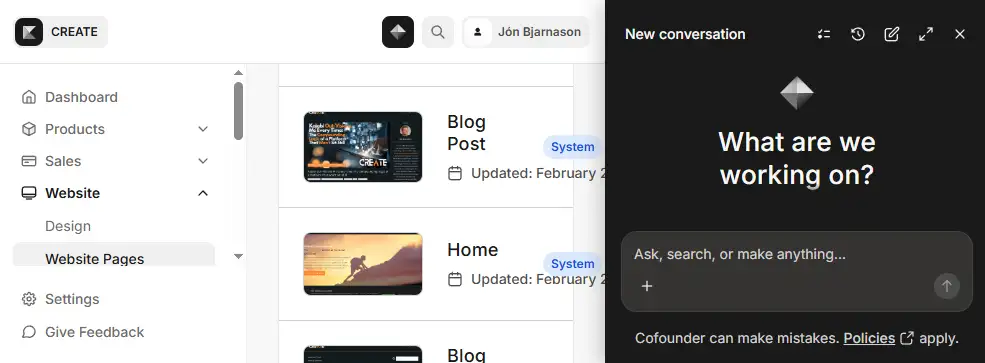
Cofounder ends the generic-AI-advice problem. The pattern I keep running into: you open an AI tool, paste a description of your business, ask for the next strategic move, and get back advice that could have been written for anyone. Generic in, generic out. Cofounder runs inside your Kajabi account with full access to what you have actually built. I tried the first version three or four months ago — sluggish but capable, and at the time I still found it easier to open Claude or ChatGPT for strategic questions. The May 2026 version is a different tool. The use case where it has earned its place in my workflow is the one I did not expect: when I need to create something in Kajabi using a feature I am not yet familiar with, Cofounder walks me through it step by step. For anyone hesitant about the learning curve on a new platform — which is the most common reason I watch people stall before they sign up — that hand-holding is the single most useful thing Cofounder currently does. The deeper category shift is the difference between consulting a stranger who skimmed your About page and consulting a partner who has watched every launch you have ever run.
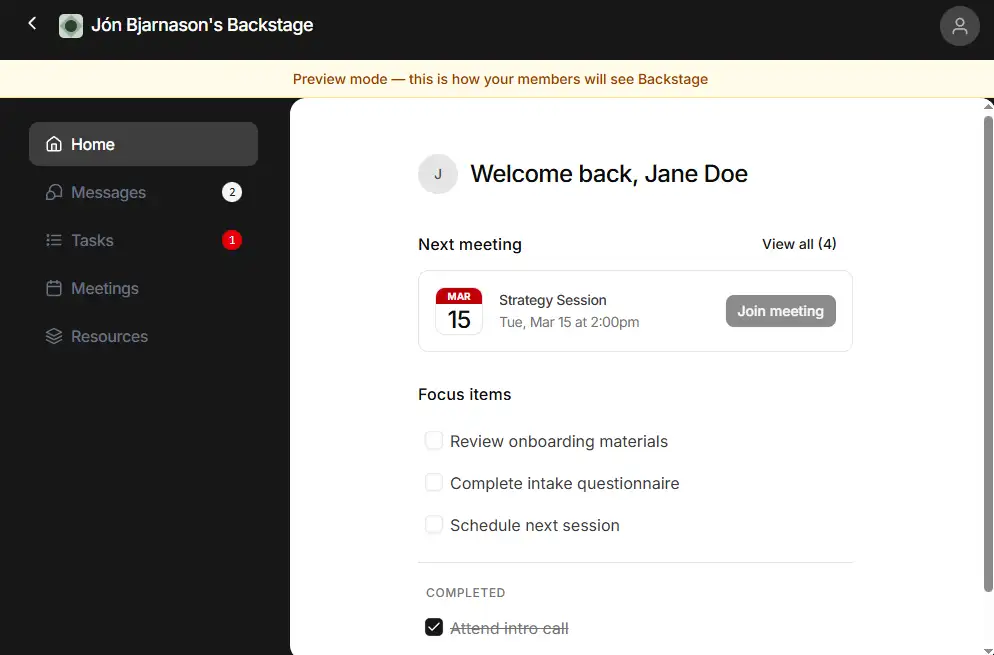
Backstage replaces the duct-tape delivery stack for high-ticket coaching. The pattern I see across every coach I work with: Zoom for sessions, Voxer for voice notes, Notion for resources, Calendly for booking, email for reminders, raw video files for replays. Each tool works. The experience of being a client is fragmented across five logins. The expertise is worth premium pricing. The delivery quietly undercuts it. Backstage replaces the entire stack with a private portal per client — sessions, voice notes, AI-summarized recordings, assigned resources, agendas, and progress visibility, all in one place. I have already been using Backstage in my own Premium 1:1 Coaching through Founder access, and the change it makes between sessions is the part I did not expect. The dialogue with the coaching client no longer leaks out across email and Messenger. It stays inside Kajabi, threaded to the client’s own workspace, attached to the work itself. The first-order effect is operational simplification. The second-order effect, and the more important one, is the perception shift on the client side. The same content delivered through a unified branded experience changes what the program feels like and, eventually, what you can charge for it.
Amplify turns the email list you already have into a revenue channel between launches. You spend hours each week writing broadcasts. Outside of launch windows, that attention is monetized at zero. Meanwhile, you pay rising prices to Meta for cold clicks from strangers who do not know you yet. Amplify resolves both sides at once. As a publisher, you add a sponsored block to a broadcast you were already going to send and get paid a flat fee for the placement. As a sponsor, you pay a flat fee to feature your offer inside another expert’s broadcast, reaching a warm audience that trusts the sender. The math is structural rather than speculative: a thousand subscribers minimum on the publisher side, one sponsored placement per broadcast, a per-send fee you set yourself, twenty percent platform commission, payment fourteen days after send. Multiply your per-send fee by the broadcasts you would carry sponsorships in across a year, subtract the commission, and you have your annual figure for revenue extracted from attention you were already generating. I plan to use it. I want to see it run first before I commit my list to it, but the underlying logic is sound, and the moment my list is at the size where the math makes sense, the option is already inside the platform I am already using.
Kajabi MCP removes admin clicking as the bottleneck on what you ship. MCP connects Kajabi to your favourite AI tools — Claude, ChatGPT, others — so you can manage your business through a conversation. “Run a flash sale on the photography course next week.” Your AI agent builds the landing page, drafts the email sequence, configures the offer, wires it together, and hands it back to you to review and go live. Kajabi describes the first-order effect as collapsing an afternoon of work into a minute. I have not yet plugged my other AI models into Kajabi via MCP — too many other things in motion right now — so I cannot describe a moment I watched that happen. But the architecture supports the claim, and the second-order effect is what I am actually watching for. When speed gets compressed that hard, the launches you postponed because setup felt like more friction than the upside become trivial. The experiments you did not bother running this quarter become two-minute tasks. The bottleneck stops being your willingness to click around an admin and starts being your ideas. That shift, if it lands as promised, is bigger than it looks.
Expert Agents closes the 11pm question gap. The pattern I have watched play out in my own business and in the businesses of every solo expert I talk to: a prospect lands on your sales page on a Sunday night, has one specific question between them and the buy button, finds no one there to answer, and closes the tab. The sale was not lost to a competitor. It was lost to silence. Expert Agents are AI teammates trained on your specific offers, your content, and your voice. A sales agent lives on your landing pages, answers questions in chat in your voice, handles common objections, and closes the sale in conversation. A teaching assistant lives inside your courses, answers student questions using your exact content, and points them to the timestamp in your video where you originally covered the point. This is the one product in the May release cycle I am going to go slowly on. I am not ready to have an AI responding to my readers or my students until I am genuinely sure I understand how it behaves and what it says. That probably means three to nine months of watching, listening, and testing before I deploy it on a live offer. The capability is there when I am ready. The decision is mine when I am.
The architectural coherence: each of these five releases targets a different specific failure mode in the small expert business — strategic indecision, fragmented delivery, cold-traffic dependence, admin friction, and the questions that go unanswered at 11pm. None of them are speculative. All of them are problems I have watched land in my own business this year, and in the businesses of the coaches and teachers I talk to.
You do not have to use them. Three questions filter the rest.
This is the line that needs the most emphasis, because it is where the case for compounding platforms is actually made.
You do not have to use all five products. You will not. I will not.
The discipline I apply to every Kajabi feature — old or new, Founder release or general launch — is three questions, in this order. Do I need it now? Does it in any way enhance what I am offering? Will this option dilute or create friction for the student or the user?
Those three questions filter almost everything, and they are not equal. The first two are about me — do I need this, does this enhance what I offer. The third is about the person on the receiving end. The first two need a yes. The third needs a no. If a feature passes both of mine and clears the user’s, it comes in. If it fails any one of the three, it stays on the shelf until the answer changes.
Across the five May releases, the verdicts come out roughly like this. Cofounder passes all three and is already in active use across my sites. Backstage passed all three for my Premium 1:1 Coaching immediately and is the most recent integration. Amplify passes the first two and clears the user’s, but waits on me until I have watched it run on someone else’s list. MCP passes all three but waits on bandwidth — I am the constraint, not the product. Expert Agents will not pass for at least another half year, because I am not yet ready to have an AI talking to my readers or students in my voice.
The phrase I keep coming back to is latent capability. Every release adds latent capability to the platform. Most of it you will not touch in the year it ships. Some of it you may not touch in any year. But the latent capability is the architecture choice. A platform with deep latent capability is a platform you do not have to leave when your business grows into a question you did not have when you joined.
That is why you do not have to use Cofounder, or Backstage, or Amplify, or MCP, or Expert Agents on day one. The day you do need any of them, you do not go shopping. You do not sign up for another tool, you do not learn another interface, you do not integrate another platform into your stack. You open the tab and use it.
What I take from a decade of this
After ten and a half years, here is what I take from it. The platform has outgrown me. The current capability surface is larger than my current operation needs. Most people read that as a problem. I read it as the entire point.
A platform whose capability outpaces my business is a platform I will not outgrow in the next five years, even at my fastest growth trajectory. The features I do not need today are the features I will need a year, three years, five years from now. They are already in the workspace I already know how to use. The day I need any of them, I do not migrate, I do not learn a new interface, I do not integrate another tool into my stack. I open the tab and use it.
I hope I never catch up. I hope Kajabi keeps outpacing me, six months and eighteen months and three years out, every time I look up. That is the version of this relationship I have been operating under for a decade. The May 2026 release cycle did not surprise me. It confirmed what I already knew.
The Compounding Logic, in Three Sentences
A platform that releases nothing new for two years is a platform you are slowly outgrowing whether you notice or not.
A platform that releases meaningful capability every quarter is a platform that is keeping pace with the businesses being built on it.
A platform that ships five distinct products in two weeks is a platform whose trajectory has compounded past the point where evaluating it on today’s features makes any sense at all.
Whose trajectory you are choosing to ride
The case for Kajabi is not the five products launching this month. The case is the pattern those five products demonstrate.
Kajabi keeps building. Every release deepens the platform underneath you. Every quarter, the subscription you signed up for is more capable than it was when you signed it up. The features you do not use today become the capabilities you need next year, already present, already integrated, already familiar interface, already inside your existing workflow.
That is the compounding logic. And that is why, for the kind of business I think most readers here are building — coaches, teachers, course creators, knowledge entrepreneurs operating mostly alone, planning to be operating ten years from now — the platform decision is not really about today’s features at all.
It is about whose trajectory you are choosing to ride.
Kajabi out-visions me every time. After ten and a half years, I have stopped being surprised by it. I have started counting on it.
Kajabi 2026 Updates FAQ
Quick answers for those evaluating the platform's new trajectory.
What new products is Kajabi launching in May and June 2026?
Between May 19 and June 1, 2026, Kajabi is releasing five new products: Cofounder (AI business partner), Backstage (private coaching portal), Amplify (peer-to-peer ad network), Kajabi MCP (AI platform control), and Expert Agents (AI sales and teaching assistants).
Do I need to use all five new Kajabi products to get value from the platform?
No. The value of a compounding platform is latent capability. Most subscribers will use two or three features immediately and keep the others in reserve. Only deploy features that enhance your offer and create zero friction for the end user.
Why choose Kajabi over other course platforms?
Choosing a platform is about trajectory, not just current features. Kajabi consistently adds significant capabilities (like Coaching, Podcasts, and Community) into existing subscriptions, ensuring your business won't outgrow the software stack.
What is Kajabi Backstage and who is it for?
Kajabi Backstage is a private client portal launching May 21, 2026, designed for coaches running high-ticket 1:1 or group programs. It unifies sessions, resources, and communication, replacing fragmented tool stacks like Zoom, Calendly, and external drives.
Before You Go — Four Questions
You have just spent time reading about why I keep choosing Kajabi after ten and a half years on it — and why the trajectory of a platform matters more than the feature list it shows you on signup day. That tells me something about where you are. But not quite enough to be useful to you.
I want to know where you actually are.
The four questions below were built using Typeform — the tool I use across all of my sites when I want to have a real conversation with a reader rather than send them a generic survey form. If you have never used Typeform before, you will notice the experience feels different: one question at a time, a conversational pace, no wall of form fields. That is by design, and it is one of the reasons I recommend it to anyone building an audience-based business who wants to genuinely understand what their readers need. You can explore Typeform here — https://typeform.cello.so/eEidFwVRfR5 — and I will mention upfront that if you sign up through that link, I receive a small commission. I believe in being transparent about that rather than pretending the recommendation is purely altruistic.
But the form below is not here to sell you Typeform. It is here because the articles I write next, the resources I build, and the products I consider creating — they all come from answers like the ones you are about to give. Your response goes directly to me. No spam. No sales sequence. Just one solopreneur genuinely trying to understand what would be most useful to the people reading his work.
Four questions. Less than two minutes. And if anything I might build next sounds interesting — you will see it in question three.
This article was authored, not generated. Built under AuI™ — the Authored Intelligence Framework. [See the framework →]
LEARN KAJABI FROM THE PEOPLE WHO BUILT IT
Free video guides, live webinars, and expert-led training — directly from Kajabi's own resource hub. Whether you're just getting started or scaling what's already working, these on-demand resources will help you move faster and build with more confidence.
Stay connected with news and updates!
Join my mailing list to receive the latest news and updates from me.
Don't worry, your information will not be shared.
I hate SPAM. I will never sell your information, for any reason.
Author